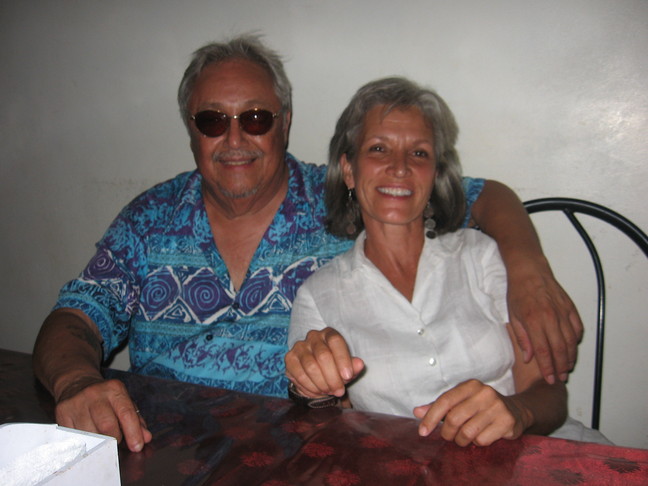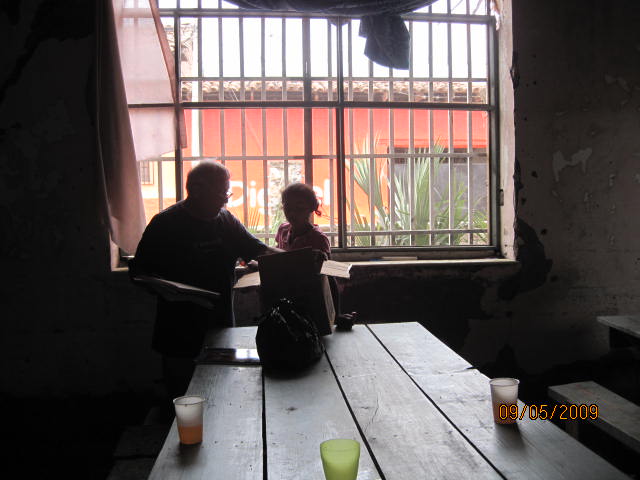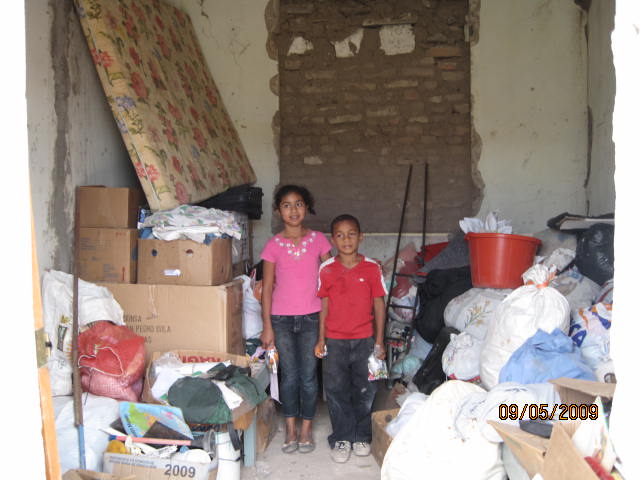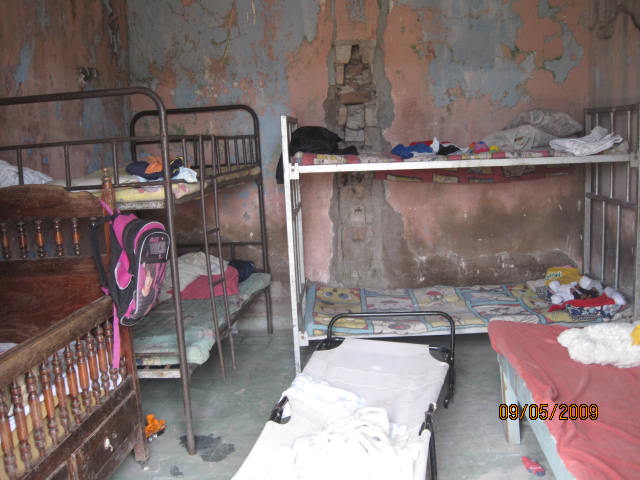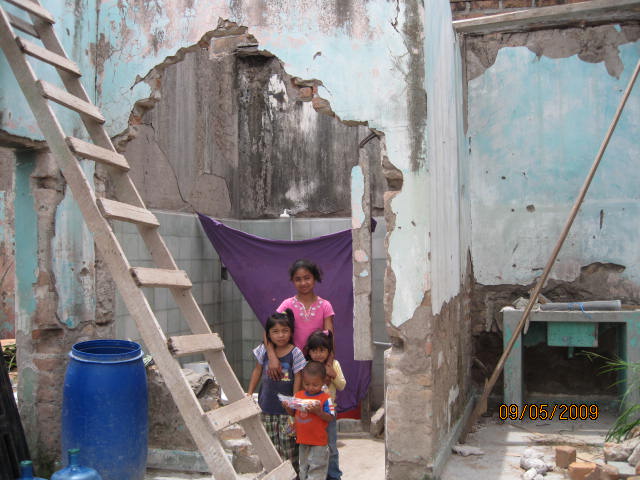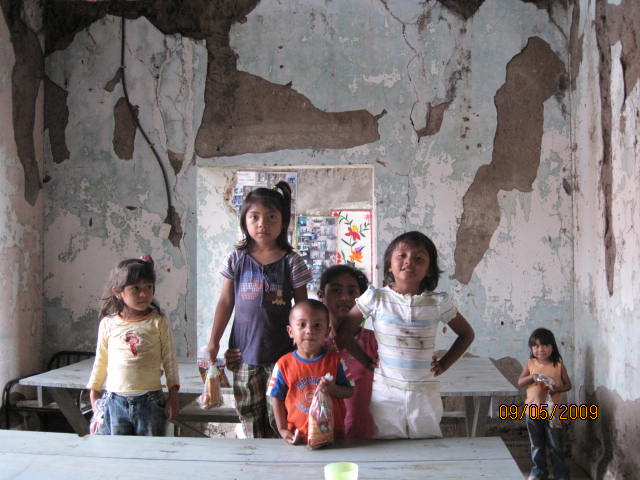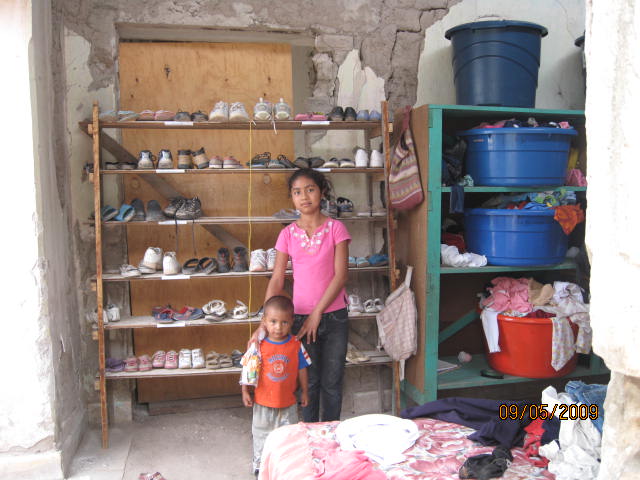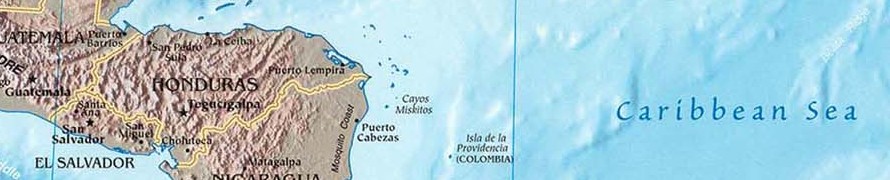
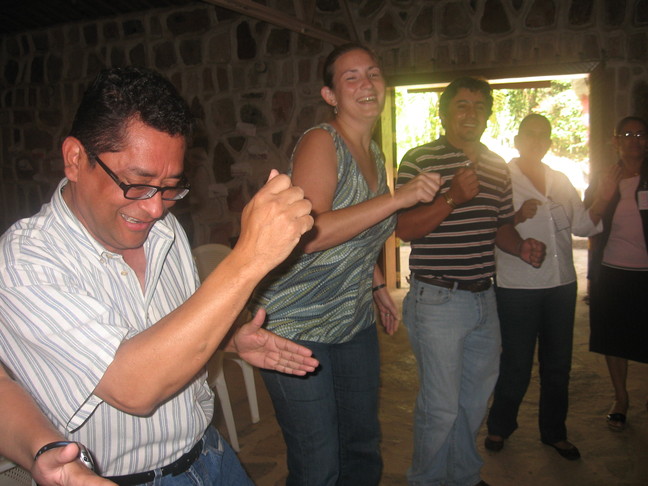
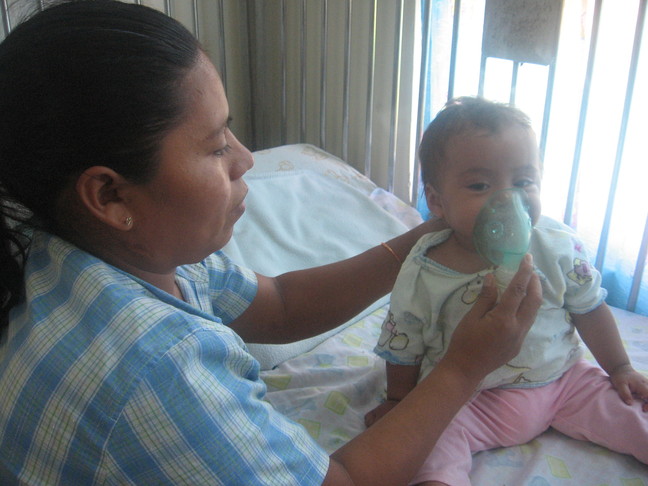
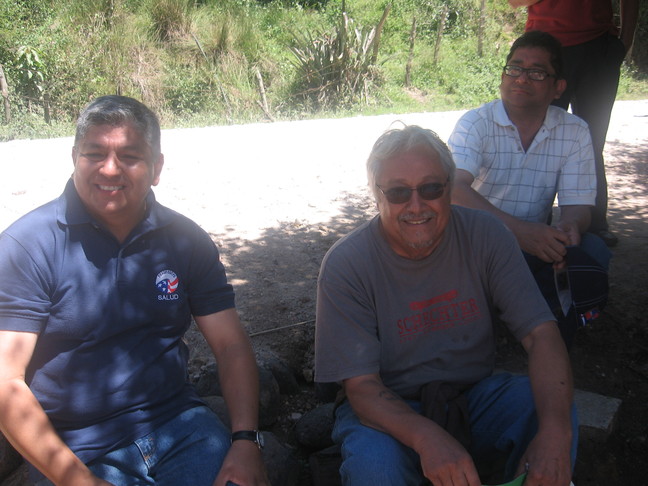
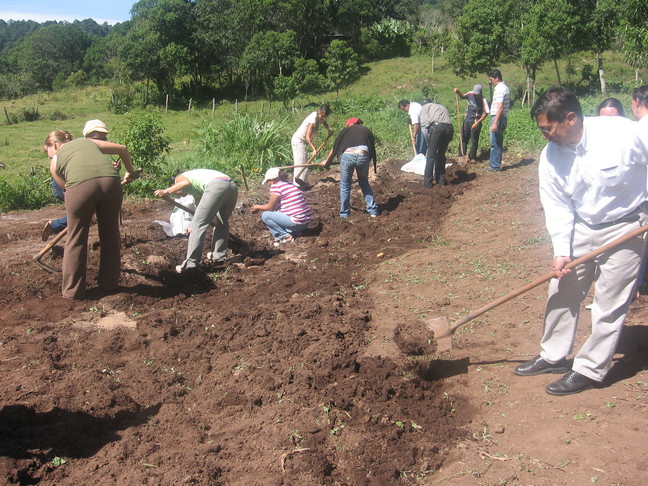
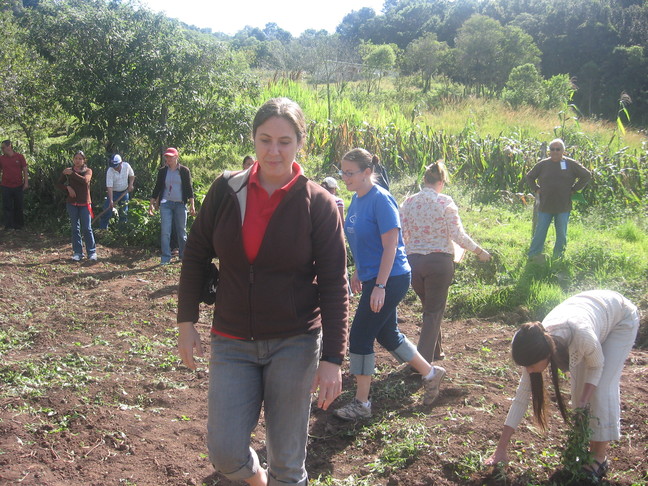
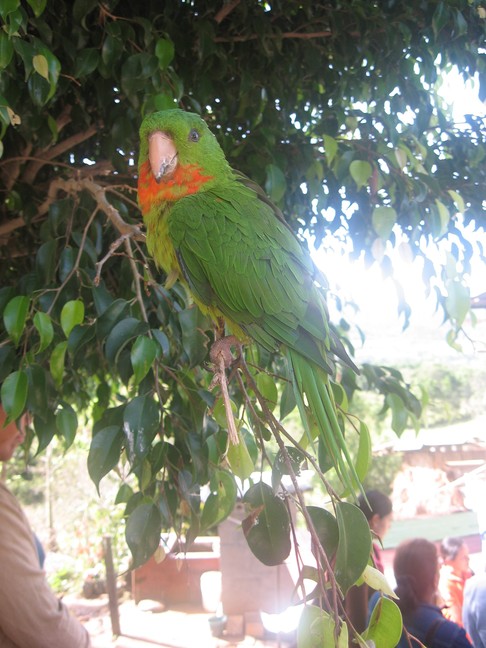
Intibuca, the city in the departamento of the same name, is the principal city at the highest elevation in the country. It is cool there in the mountainous country nestled within the tall peaks, its own little environment far from the lowland heat. From September 30 to October 3rd the Peace Corps hosted a taller there focused on Maternal/Child Health with an emphasis on healthy eating and common childhood illnesses in Honduran children such as malnutrition, dehydration and pneumonia. The two bottom right pics are of the resort, Los Pinos, where we stayed. Each PC Volunteer brought two Honduran contrapartes; all Peace Corps training staff are Honduran. In the middle pics a friendly parrot greets us to an organic farm where we all pitch in to prepare the ground for planting seeds, with a corn treat afterwards. The next day we went to a local hospital for more field training. And, of course, we had a fair amount of classroom training livened up with action dinamicas. Our inservice training is designed to foster cooperation and teamwork, form friendships and create a great learning environment as each culture learns from the other.
Mountain High
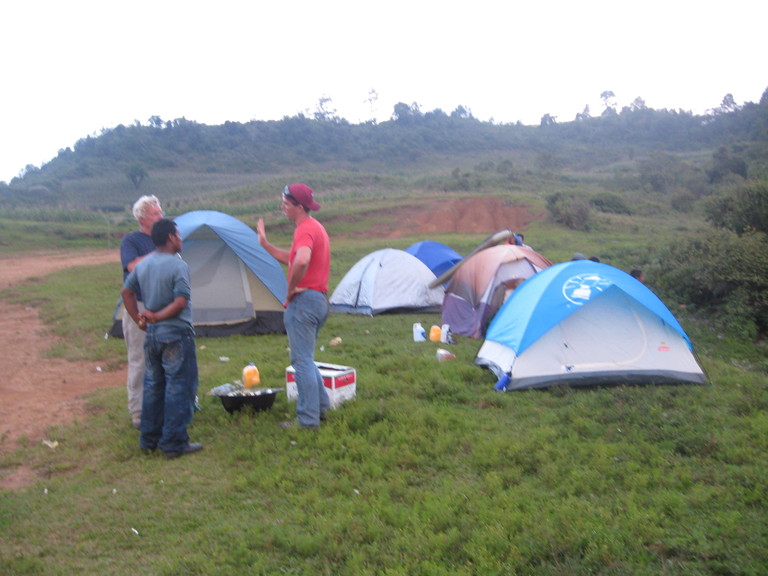
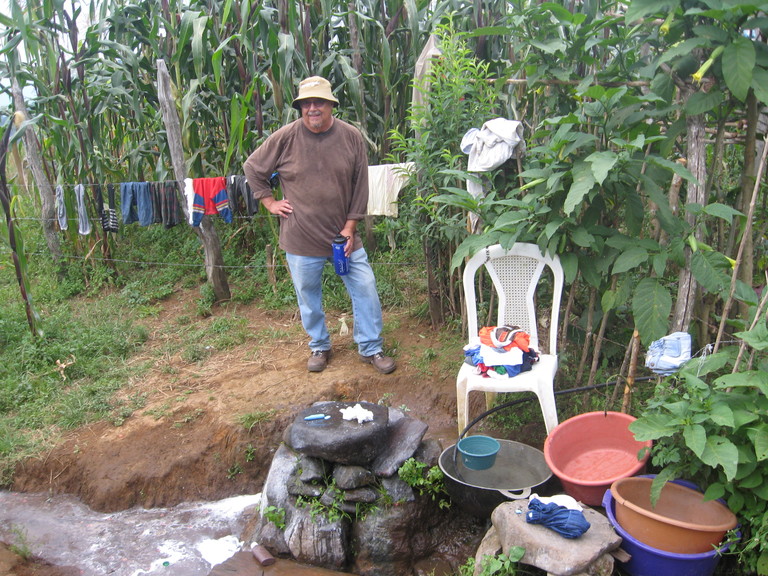
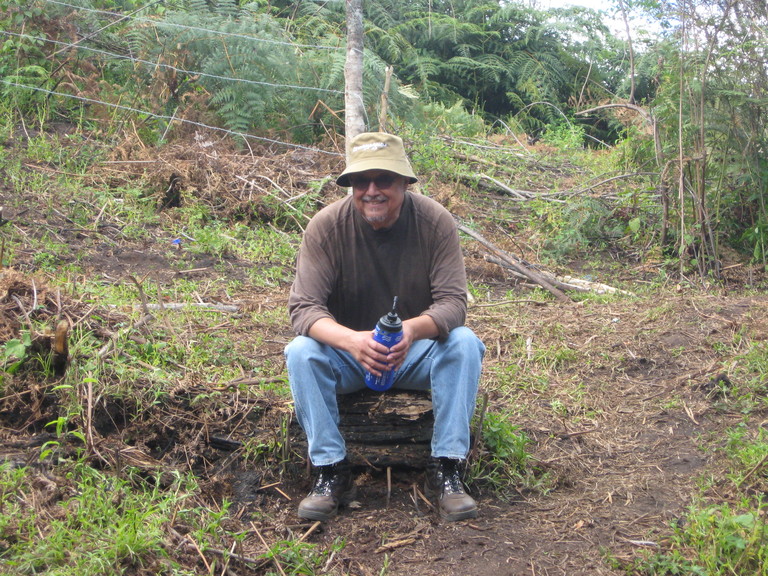
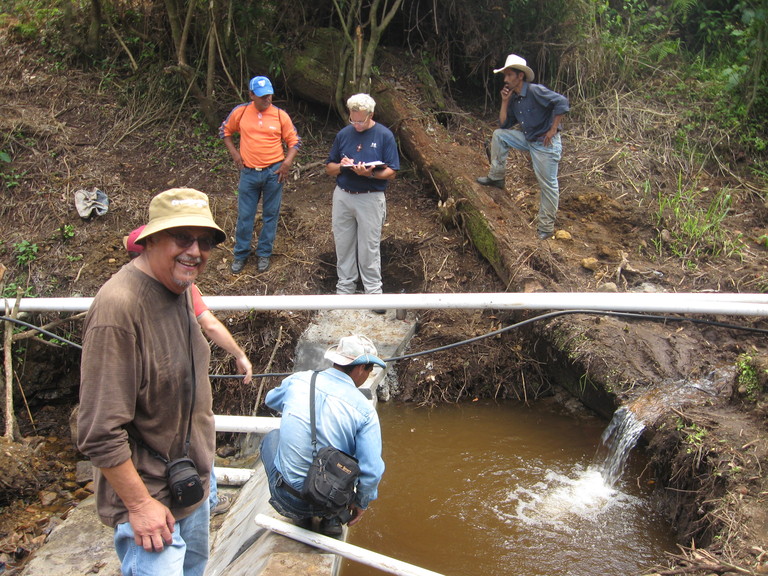
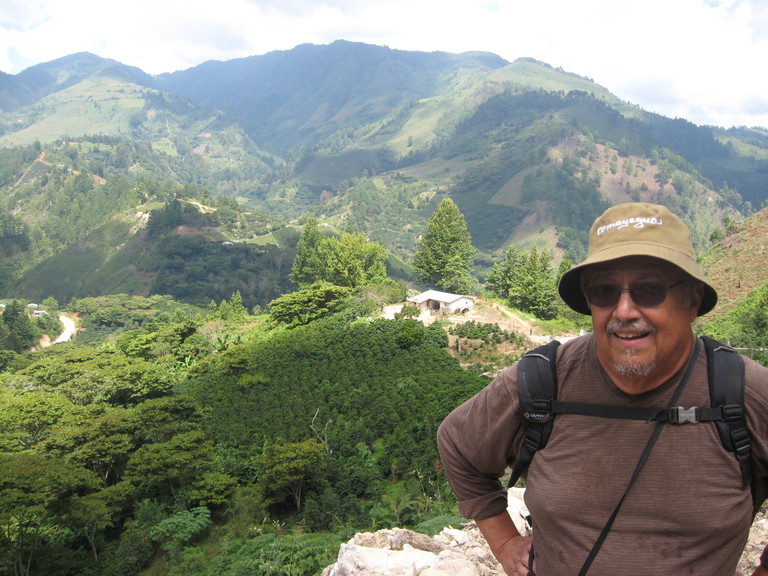
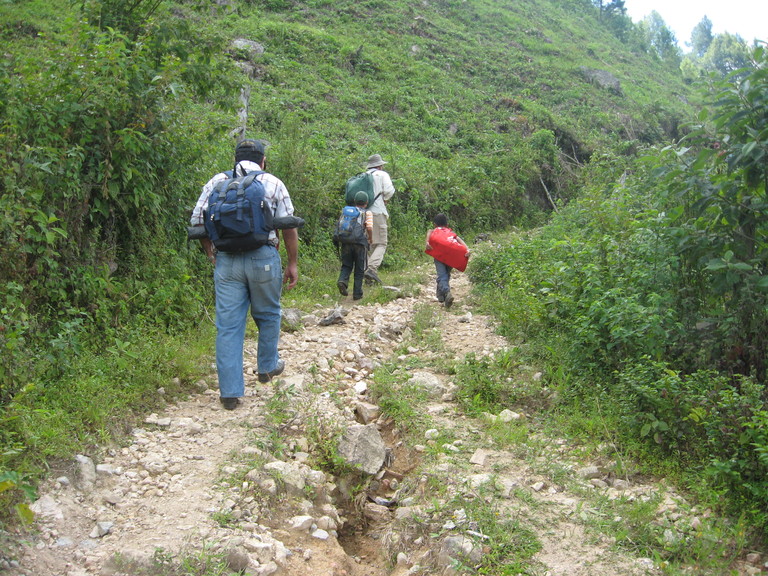
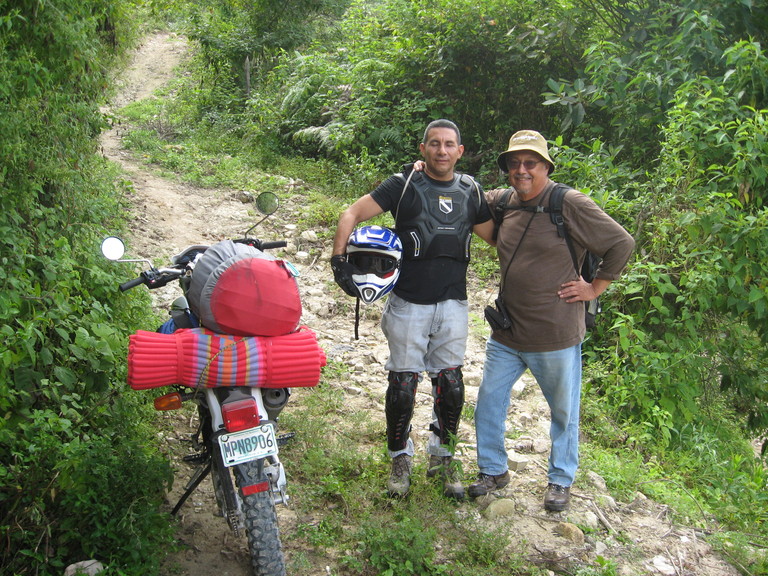
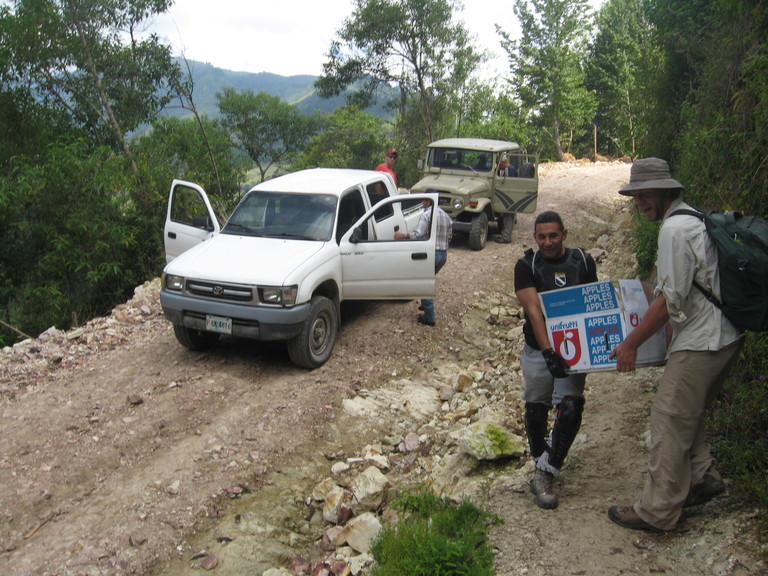
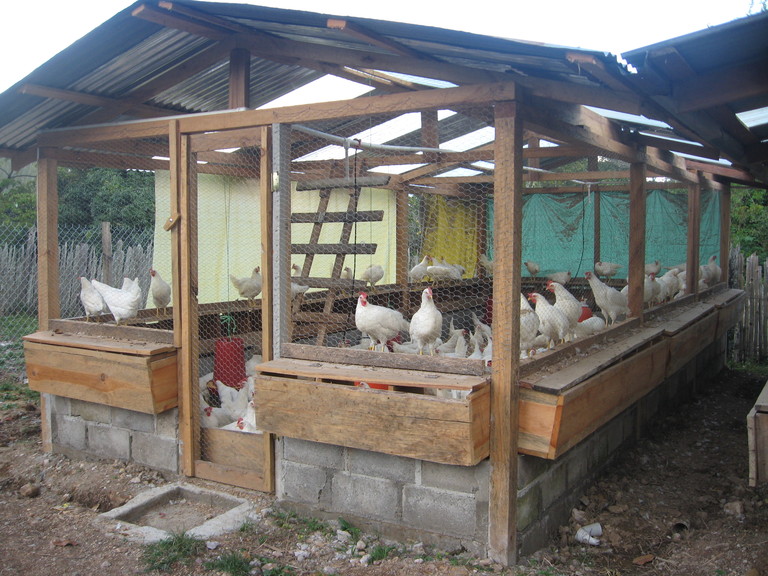
From September 14th through the 21st I hung out with my friend Nico, a former PC Volunteer who returned to Honduras with a brigada from Virginia Health Center and his friend Dan, the auditor for the water projects. In company with several Honduran engineers and other central figures we visited 3 different water projects in various stages of development as well as the dedication of a new health center. On one side of the Comayagua Valley we ascended the Cordillera de Montesillo, the highest reaches on foot to 2,092 meters, and on the other side of the valley we ascended the Cordillera Merendon by Range Rover. For a sense of direction, the bottom row, right side pics are of our arrival at the trailhead. We walked up and up to where we pitched our tents. Then we walked higher and higher to the two middle pics in the second row where were located two natural springs that are the origin of the water source, hitting 2,092 meters (over a mile high). By that time I wished fervently for that kid’s mule. The second left pic in the top row is the medical clinic dedication. And the last left pic in the top row is of a chicken coop at an orphanage in the mountains on the other side of the Comayagua Valley where we went to review another water project. The political situation in the country remains unsettled: politicos fighting over power and privilege, the population be damned. Sounds somewhat like the political situation I left back home.
Tiptoeing through political tension
The toque de queda is not 24 hours these days, but it is still imposed nightly, arbitrarily it seems, 6 pm to 6 am yesterday, or 9 pm to 7 am tonight. Most commerce here in La Paz is back to its usual pace. The de facto government in Tegus is still rattling swords at the Brazilians, making unenforcable threats. I think they know that if they storm the Brazilian embassy to arrest President Zelaya the mierda will hit the fan, not only internationally but locally. Meanwhile, my chicken pen for the orphans has hit bureaucratic obstacles; perhaps a metaphor for the national condition. Tuesday I leave for the mountain aldeas with profesores from the Instituto Lorenzo Cervantes to supervise final year secondary students preparing for their Bachillerato en Salud Comunitaria diplomas present information from an HIV/AIDS workshop I prepared for them that they in turn will present to their mountain student peers. Wednesday I leave for a 4-day taller in La Esperanza, Intibuca to be focused on Maternal Health and Child Malnutrition in Honduras. Kwashiorkor and Marasmus syndrome are not unknown here. That information I will put to good use, along with my three Honduran counterparts attending with me, in follow-up visits for children diagnosed with malnutrition and discharged from the hospital to the rural aldeas where ignorance and illiteracy run rampant. After I return, I hope to post photos from my week-long mountain trip to the mountain aldeas above Comayagua last week, as well as pics from the taller at Intibuca. Life goes on, while the politicos make fools of themselves.
Toque de Queda
The day before yesterday, Monday September 21, 2009, President Mel Zelaya returned to Honduras overland, by stealth, and ensconced himself in the Brazilian Embassy. At first denying that Zelaya was in the country, the de facto government that deposed him subsequently imposed a 24-hour toque de queda (curfew) on the country that remains in effect today, demanding that Brazil hand Zelaya over for arrest by Honduran authorities. The airports are closed, buses aren’t running, all the country’s teachers (Zelaya supporters) are on strike, hospitals are not open for business, and most commercial establishments are shut. The country is at a stop. The de facto government has erected roadblocks around the country to prevent Zelaya’s supporters from converging on the capital. The Brazilian Embassy is surrounded by armed troops who are dispersing the gathering crowds with tear gas and water cannon. Demonstrators are being beaten and arrested. The embassy’s water, phone service and electricity have been cut off. All food and medical services have been blockaded. Here in La Paz the situation is quiet but the country is paralyzed by the political turmoil. Our three supermarkets are closed as well as most businesses and no buses or taxis are operating. The situation is volatile.
Partying With the Cuban Doctors
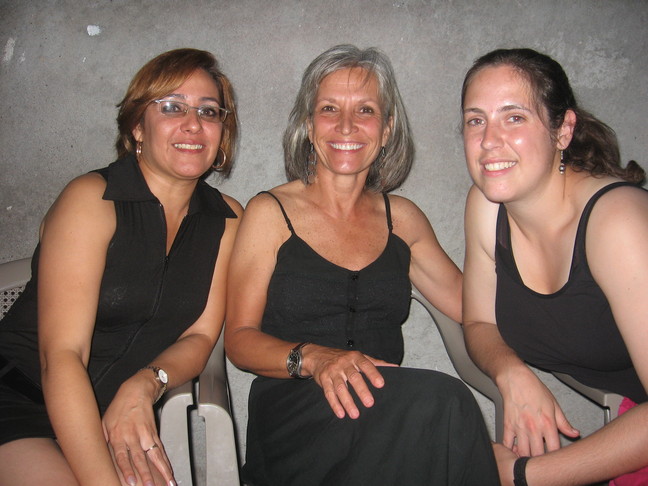
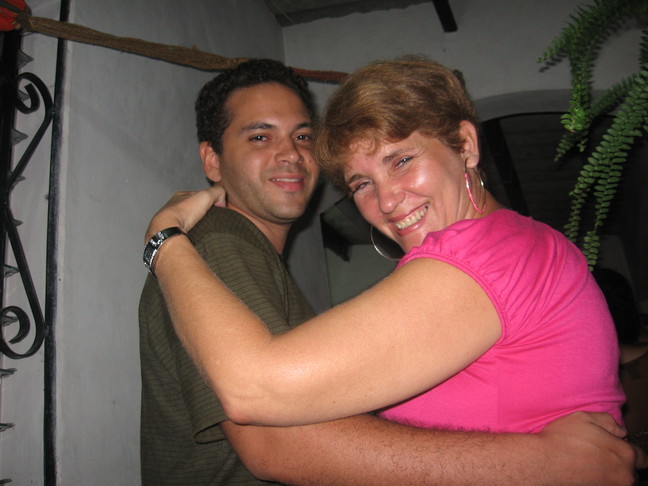
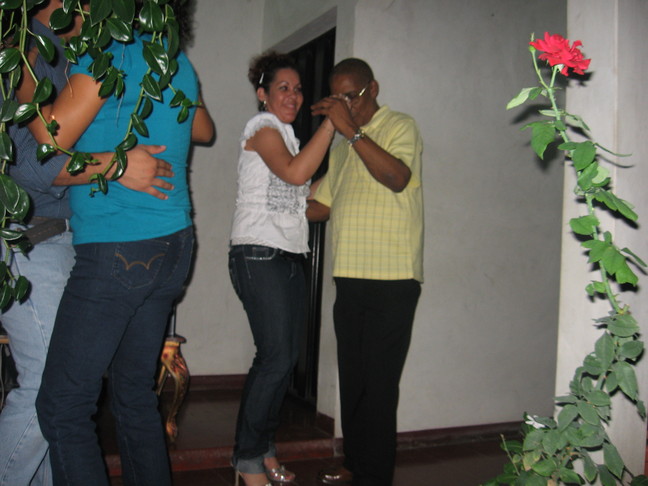
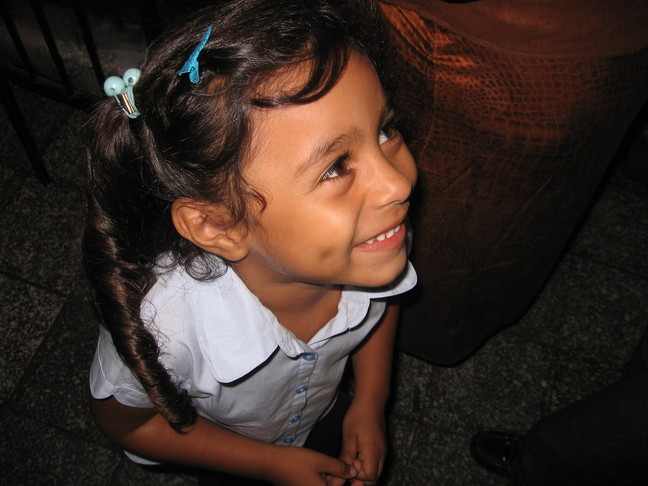
The above melange of pics is from two separate parties with a group of Cuban doctors. After Hurricane Mitch devastated Honduras’ infrastructure in 1998 and caused tens of thousands of deaths, Cuba sent in teams of medical professionals to help with the rebuilding of the country. Many are still there. They are sent by their government for two years of volunteer service and earn far less than the pittance of a stipend that Peace Corps Volunteers earn. In any event, 7 doctors assigned to aldeas around the La Paz municipio are friends of my host family and occasionally they gather for fun-filled get-togethers dedicated to good eating and dancing. The first party occured my first weekend in town, and the second was last night (Saturday). The pics above are 8 of 50. My friend Taylor took most of them: also Caterin, the little dimpled pixie, a neighbor. Dr. Ishmael, the gentleman concocting the beautiful tomato and veggie salad is a surgeon with more than 40 years experience. He is so skilled that the U.S. Air Force surgeons attached to Palmerola Air Force Base nearby come to our La Paz hospital to learn from him. Other specialties are Pediatrics, Plastic Surgery, Rheumatology, and General Practice. All free, courtesy of the Cuban government. In the morning I leave for the mountain aldeas accompanying a brigada from a U.S. university for a week. A new health clinic is being opened in one of the aldeas.
A Chicken Pen for the Kids’ Chickens
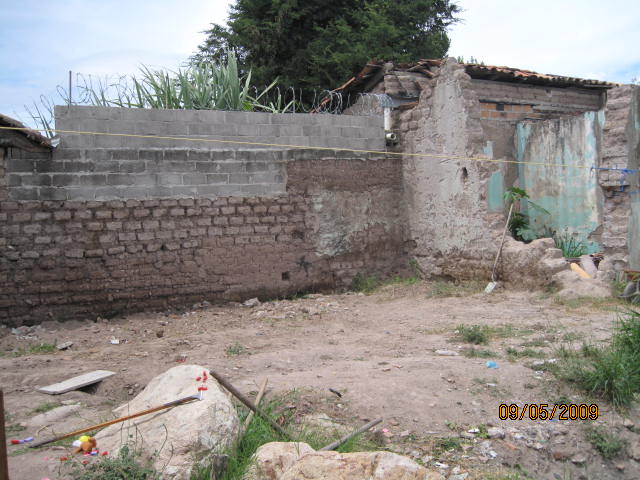
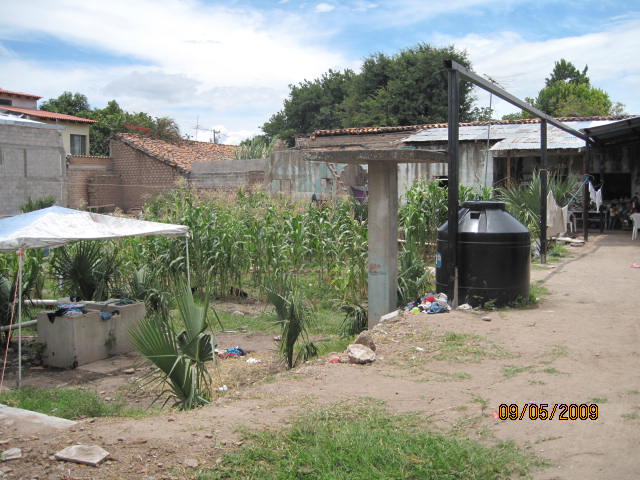
Sister Edith agreed with me that the first goal on the agenda should be the penning of the chickens in a secure enclosure. The chickens running loose are everywhere and eat everything in sight – they ocassionally pick the tortillas from the youngest childrens’ hands when the kids are at table. They also shit and lay eggs anywhere they want. Who knows where they roost, as there is sure to be a pile of feces down below; if I wanted to find out. Once the chickens are penned we can work on a garden to provide sustenance, and chicken products can be harvested, not to mention the improvement in hygiene. The two middle pics in the second row show an expanse of corn the Sister planted before the chickens were donated. Next to that is the site we have cleared to put our new chicken coop. I am only able to work at the orfanato on Saturdays as I have started working at the local colegio giving classes and at the city hospital following up on malnourished children in the rural aldeas when they are released from their inpatient hospitalizations. There is much work to be done.
el orfanato
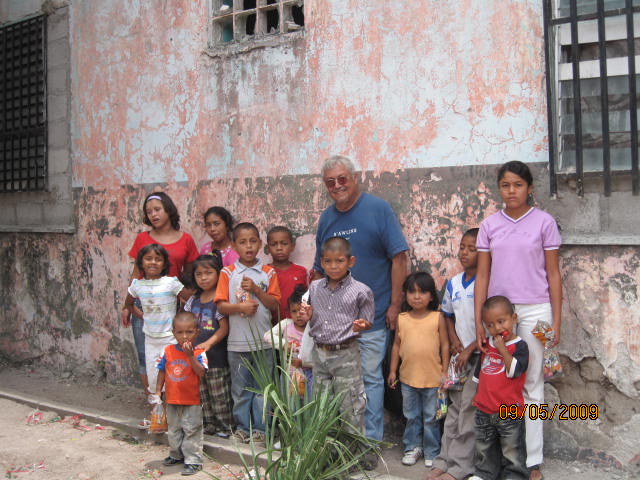
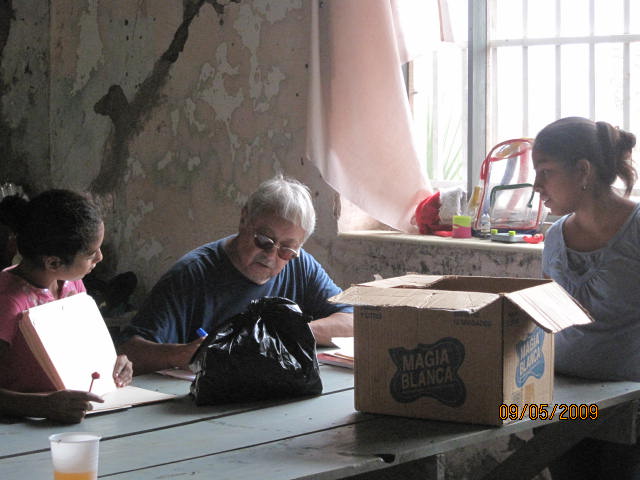
I stood outside the orphanage for a few moments to take in the crumbling building and see what changes had been made in the three months that I had been gone. Except for the missing huge pile of dirt in the front yard everything looked the same as when I left. I knocked on the front door and a child peeked out the tiny imbedded window. “Es Fortunato!” I heard from inside and the door popped open. A few of the kids came rushing out of the newly created dining room as I entered, Hermana Edith following with a smile, the children asking questions and hugging and asking if I remembered their names. I told the nun that I had encountered Ana, Merlin, and Nicole carrying buckets full of corn kernels out on the street, as I stood amid a pile of shucked corn husks scattered on the floor. Yes, she replied, they were on their way to the miller’s; they would return with flour to make corn tamales, their dinner for the day. Someone had donated a pile of ear corn, she said, inviting me inside. I told Hermana Edith that I had been reassigned to La Paz and would be here for two years and that I intended to resume my volunteer activities at the orphanage. The interior of the orfanato had been made habitable in one corner of the large abandoned building. They had a kitchen, a bathing area and bathroom, two large bedrooms of sorts, and a room where makeshift cubicles had been installed containing clothing for each child. The children led me around, proudly showing off their meager accomodations, the partially painted walls crumbled and flaking from 25 years of neglect. I learned that someone had donated a few baby chickens that were now everywhere underfoot and had promptly eaten the garden the nun had planted from the seeds I had given her when I left for La Masica, including all the seeds. I told her I would return on the weekend to make plans and left, a lump crowding my throat.
La Paz Redux
The bus driver grumbled and griped that my ticket should not have been issued to the Conejo desvio exit to La Paz. “Este bus es un directo a Tegucigalpa,” he complained. I shrugged my shoulders and insisted that I had to get off at the Conejo desvio; I was a Peace Corps Volunteer on a mission. Reluctantly, the driver stopped the bus at the isolated desvio and unloaded all four of my suitcases from under the bus, then roared off down the Pan-American highway towards Tegus. I struggled down the side of the highway lugging four suitcases towards the desvio and luckily a yellow chicken bus appeared from the opposite direction at the very moment I arrived, and turned into the intersection headed toward La Paz. “Subase, subase,” the ticket taker barked as he loaded my suitcases into the chicken bus’s undercarriage, the bus barely slowing down. I climbed aboard, rode the 10 kilometers into La Paz, and caught a taxi to dona Luz’s house where she had a fabulous lunch waiting for me. Hugs and remembrances all around. Two days later I walked over to the orphanage in the morning; as I turned onto the street where the orphanage is located I saw three children walking up the street toward me, each carrying buckets of corn kernels. They stopped in mid-stride. “Fortunato!” they cried, and rushed to hug me. After trying to answer their multiple questions, I told them I would be at the orphanage talking with the Sister and would see and talk to them later. I told them I would be living here for the next two years. In my next posting I will describe the re-immersion of my new life into the municipio of La Paz and the emotions and reconnections that have extended in waves with each passing day.
Return to La Paz
My early morning Linea Cristina bus rolled through the northern coast’s fecund green carpet of tropical forest, banana plantations, pineapple fields, coconut trees and palm oil stands from La Ceiba to San Pedro Sula where the two-lane highway turned south and edged into the mountains toward the interior. The country only has a smattering of four-lane highways in its two largest cities, Tegucigalpa and San Pedro Sula. Its third largest city, La Ceiba, has none and nowhere else that I have traveled have I seen any. Nonetheless, Honduras’ network of paved two-lane roads criss-cross its mountainous terrain in every direction providing public transport cheaply and efficiently. As we lifted from the coastal plain the forest morphed into a coniferous expanse of pine, fir and spruce trees and the clammy humidity gradually became a thing of the past. The three-hour trip wound its serpentine way steadily up and around mountain after mountain until cresting just before reaching the rim of the Comayagua Valley on the other side of the range. Once we reached Siguatepeque on the downward plunge about 15 kilometers from Comayagua I felt that I was almost home. La Paz is a mere 30 – 40 minute ride from Comayagua. In my next post I will describe my homecoming and the orphanage….
Santa Rosa de Copan
Destinations like this beautiful little mountain city are why I miss my stolen camera so much. It took 7 hours to arrive here from La Ceiba hoping our travel would not be disrupted by the persistent road blockages and demonstrations that continue to plague the country. Along with several of my fellow Peace Corps Volunteers accompanied by contrapartes from their local communities I was in town to attend a 3-day taller (workshop) about Micro Empressas (micro businesses) with a focus on People Living with HIV/AIDS: important because of the stigma and discrimination these people must deal with in their local communities. The smaller the community, the worse its reaction. The taller was a success, my contrapartes and I learned the mechanisms for starting and sustaining a small business, information to be passed on to peers all over the country. During free moments of my 3 days on site I walked the narrow cobble-stoned streets of a city situated on a series of hilltops, manuevering the unique person-wide sidewalks and absorbing its antique European-like ambience. Watching the sun set over the city from the hotel’s rooftop reminded me of Van Gogh’s Starry Nights canvas. And the cemetery … almost beyond description. The cemeteries of New Orleans pale in comparison. Magnificent, colorfully painted, chalet-like mausoleums packed tightly across hilltops overlooking the city give the impression of a city of the dead overlooking the small bustling metropolis below. I will miss the Seattle-like climate here in Santa Rosa de Copan, for on my return to the steamy north coast I will pack up my bags once again and transfer into the interior of the country by the 15th of the month.